The interfingering between people and rock


Photo of Hafod Eryri, the Welsh name for the building, from Snowdon Summit Blog
Slate quarrying was long Wales’ claim to fame and one of the most important industries in the country. Welsh slate was shipped around the world for use as gravestones, school slates, and most famously, for roofing. The men of the Welsh slate industry also traveled far. Poor working conditions, poor pay, strikes, and food shortages led to an exodus of Welsh workers to America in the 1840s. Their arrival jump started the nascent American slate industry and within a handful of years, slate from Pennsylvania, New York, Vermont, and Maine became the plastic of its day, a nearly ubiquitous material in the building trade.
Oddly, however, instead of using the 400-million-year old slate found on the sides of Snowdon, builders of the new structure imported their slate from Portugal. (Local granite, however, does clad the building.) I am sure that money was an issue but it seems odd to me that it wasn’t possible to find enough local slate to cover the roof of the building. Couldn’t the builders have simply gone around to abandoned quarries and just picked up some left over blocks of slate and made new roofing?
Photograph courtesy of Sid Perkins, who retains the copyright.
Named for Crab Orchard, Tennessee, which in turn is named for groves of crabapple trees, the rock first reached national prominence in the 1920s. Prior to that, it had mostly gone into flagging, sills, and foundations. According to a 1961 report by the U.S. Bureau of Mines, large scale quarrying started around 1926, when architect Henry Hibbs sought stone for Southwestern University in Memphis. Several quarries still produce the stone, which in 2001 went into and onto the Country Music Hall of Fame, in Nashville.
Photograph courtesy of Sid Perkins, who retains the copyright.
The Crab Orchard is a beautiful sandstone ranging in color from tan to blue gray with shades of yellow, pink, purple, and brown. Adding to the appeal, the colors appear as lines and swirls, many of which form geometric patterns. Dense and fine-grained, it is “relatively impervious to moisture, and comparatively inert to acid or fumes encountered in manufacturing areas,” or so wrote the Bureau folks in 1961. They also observed that dirt and soot could be readily washed off. What more could one want?
Photograph courtesy of Sid Perkins, who retains the copyright.
Some controversy exists about deposition of the Crab Orchard stone. Some geologists propose that it occurred in braided streams and some that deposition took place in “back-barrier, tidal flat, and tidal channel or delta sub-environments within a barrier or marine-dominated deltaic system.” But all agree that deposition took place in the Pennsylvanian.

The Aon Center, formerly known as Big Stan then Big Amy (from Wikipedia)
Big Stan, as wags dubbed it, was the apogee of Carrara marble construction. First quarried in the middle 1st century BCE, Carrara was the marble that allowed Augustus to make his famous boast of finding Rome a brick city and leaving it a marble one.
Augustus may have exploited it as a building stone but Michelangelo was the person who bestowed grace on Carrara marble. Michelangelo first used Carrara for his Pietà , which he followed three years later with David. Completed in 1504, David sealed Michelangelo’s reputation as the greatest sculptor and Carrara’s as the most ethereal and eternal stone. What better way than to illustrate the permanence and prominence of a titan of business, particularly one dedicated to a geologic pursuit, than to erect a 1,136-foot-tall tower of marble? Designed by Edward Durell Stone, Big Stan was begun in 1970 and completed in 1972.

Quarrying in modern Carrara
Panel problems appeared within a few years. By 1979, over 2,000 panels had cracks and bowing. Before replacement, 31 percent of all panels arched at least 1/2 inch. Standard Oil (now known as Amoco) considered seven options before deciding to replace every panel with a white granite quarried in Mount Airy, North Carolina. Recladding occurred between 1988 to 1992.
Geologists traced panel failure to two factors, both related to the marble’s geologic history. Carrara is nearly pure calcite, a fact much ballyhooed by Carraraphiles because it makes the marble brilliantly white and excellent for carving, but which weakens the marble because of how calcite responds to temperature change. When heated, calcite expands and contracts differently along different internal axes and, when cooled, it cannot return to its original shape because the crystals interfinger with each other. With growth in one direction and contraction in another, failure was inevitable.
Quarrying is a very, very big business in Carrara
Carrara’s purity results from the first stage of its formation, 200 million years ago in a shallow, warm sea, just north of the equator at the eastern edge of the supercontinent of Pangaea. Numerous invertebrates as well as algae and single-celled critters called foraminfera generated huge volumes of calcite, which accumulated as skeletal fragments, mud, and spherical grains and later solidified into a homogeneous limestone.
The limestone metamorphosed into a marble 27 million years ago when a small tectonic plate rammed into Italy and shoved a suite of rocks into a layered stack, which included a 200-million-year old limestone. The weight of the rocks generated heat and slowly began to bake the limestone and convert it to the Carrara marble.
Metamorphism created the second problem for the Amoco Carrara panels by aligning minerals. After temperature changes weakened the marble, it became susceptible to a release of stress, which had been generated by the overlying sediments aligning minerals and grains. (Stress release has long been known at Carrara quarries, occasionally leading to rocks exploding on trucks several days after they have been cut.) Weakened panels were further sapped of strength by water, which expanded during freeze/thaw cycles.

Brown obtained his unusual building material from wooded hills 20 miles south of Lamar. (Curiously, one person who helped build the station was Bill Mitchell, who later achieved fame for inventing the infamous candy, Pop Rocks.) First described in 1895, some of the petrified logs are up to 30 feet long. Surprisingly, few modern geologists have studied the petrified wood mostly because Brown was not alone in pilfering the fossils. Many people simply drove out ranch roads and loaded their trucks with what they found. A geologist who has worked in the area reports that there isn’t enough “petrified wood of that quality to build a bird house, much less a gas station.”

Brown’s petrified wood began life 125 million years ago on a relatively flat, semi-arid landscape that tilted down to a coastal plain to the east. North America was located a bit south of its present location but a sea had begun to move in from the north, which by 85 million years ago had split the continent into two massive islands. Large streams flowed out of nearby hills, crisscrossed flood plains, and removed most plants and animals that could have fossilized except for trees, some of which are now found in the gas station.

Photo courtesy of Dorothy Smith • Circa 1936
Only three month’s after the Brown’s station opened, Ripley’s Believe It or Not! mentioned it in a column. The caption read “The Petrified Wood House, Built Entirely of Wood Turned to Stone.” Brown had a sign made with this caption and placed it on the front of the station.
Brown’s gas station also interested Frank Phillips, the founder of Phillips Petroleum, the type of gas that Brown sold. Phillips tried to buy the gas station, which he hoped to ship to his Oklahoma estate. When Brown found out that it was Phillips who wanted to buy the building, he immediately jacked up the price. Phillips, who was known to be a cheapskate, refused to buy it. Instead, his agents surreptitiously bought 48,025 pounds of petrified wood at $1/ton and shipped the petrified wood to Oklahoma, but Phillips never built a copy of Brown’s filling station.

Photo courtesy of Carolyn Peyton • Undated
Six months after his purchase, however, Phillips did become owner of a new petrified wood building. On December 2, 1939, when Phillips turned 66 at a huge bash in Oklahoma, three Lamar residents associated with Brown’s station gave Phillips a model of the station. After Phillips’ birthday, the little gas station was placed on display at his estate and was thrown out sometime in the 1950s, although no one knows exactly when.
Red Mathews and the model station he and others made for Frank Phillips- 1939
Brown owned the station until he died in Lamar on November 2, 1957. The little building has not been a gas station for several decades but the weathered sign is still above the single bay door and the present owner says that people still stop by to take a photo of “The World’s Oldest Building.”

Starbucks' remodeled store in Seattle (from the Seattle Times)
Blackboard slate came primarily from Lehigh and Northampton counties in Pennsylvania. The metamorphosed stone began as a sediment deposited in an ocean, when rivers carried clay, silt, and sand off North America and out into a deep marine basin. The 450-million-year old sediments first formed into shale, followed tens of millions of year later by metamorphosis to slate, under thousands of feet of rock. At present, up to 7,000 feet of slate beds make up the valleys and ridges around Pen Argyl, 60 miles north of Philadelphia.

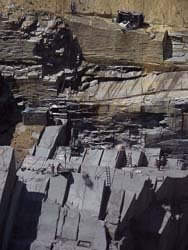
Pennsylvania slate (from Penn Big Bed Slate Co. Inc. web site)
Smooth, durable, and uniform, slate took chalk easily and legibly, didn’t absorb water, and stayed straight and true. By 1905, the majority of blackboard makers in the United States sold boards of slate. Six years later, the Cyclopedia of Education reported on blackboards that “It is doubtless no exaggeration to say that [slate]…should be used for all brick, stone, or concrete buildings.”
Blackboards are a wonderful teaching tool. They don’t break or warp. They can be cleaned indefinitely, either with an eraser or with your hand. They produce a pleasing click-clack sound when written on properly. Often taking up an entire side of a room, they provide a huge space for jotting down anything from music to drawings to numbers. They also seem eternal and permanent. Just think of the photographs of Einstein, or any number of mathematicians and physicists, writing out elaborate equations on a blackboard and you will recognize the role they have played in education and communication.
Or consider how our use of blackboards has seeded our language. We wipe the slate clean or start over with a clean slate. We chalk up something to experience. We refer to a tabula rasa, literally a scraped tablet, but more often defined as a clean slate. We vote for one of a slate of candidates. We are slated to do something and those who had a debt were formerly said to be on the slate. No other stone has contributed a comparable literary etymology.